Academic work

Research

My work sits at the intersection of neuroimaging, attention, and prefrontal cortex organization — using fMRI, diffusion tractography, and meta-analytic methods to chart how these systems are structured and connected.

Selected publications

Figure from Surface-based Tractography uncovers 'What' and 'Where' Pathways in Prefrontal CortexFigure
2026 · Cortex

Surface-based Tractography uncovers 'What' and 'Where' Pathways in Prefrontal Cortex

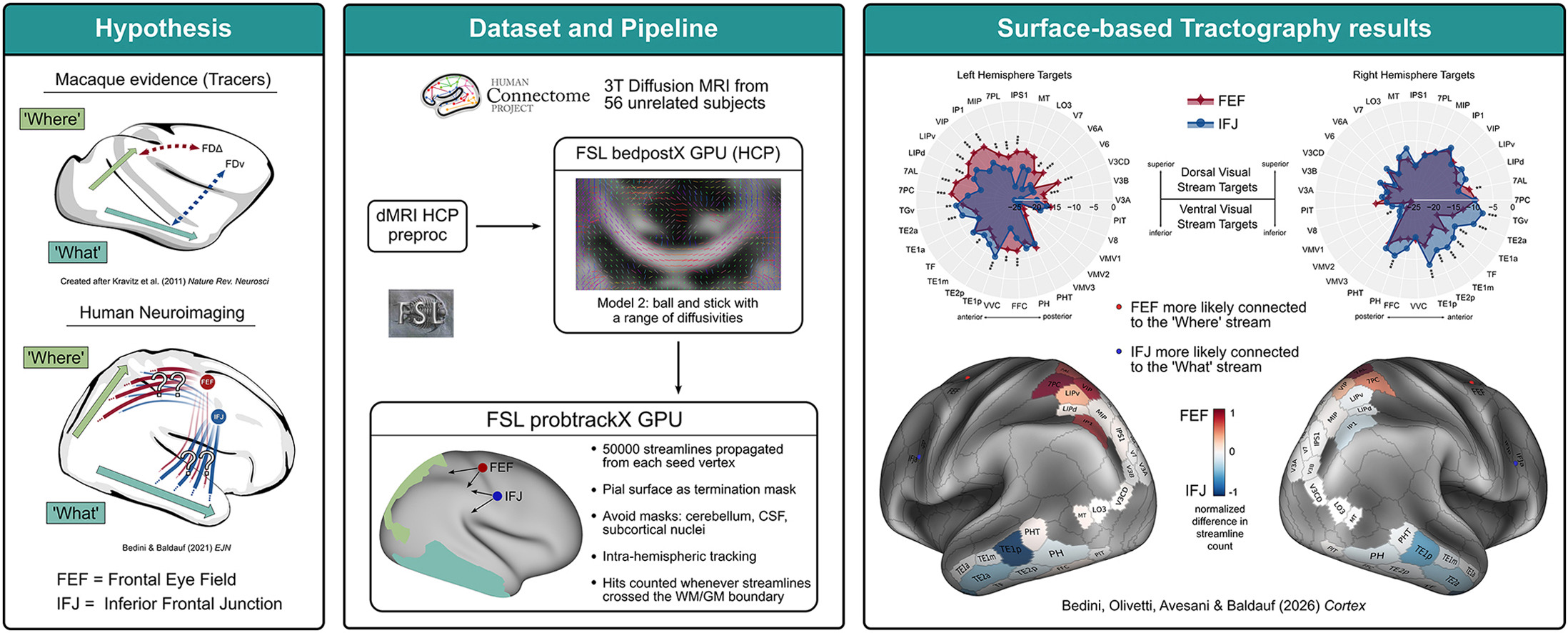
Surface-based tractography shows the FEF and IFJ extend the brain's two visual-stream architecture into prefrontal cortex, supporting their specialization in spatial versus non-spatial control

Read abstract

The frontal eye field (FEF) and the inferior frontal junction (IFJ) are prefrontal regions that mediate top-down functions, with mounting neuroimaging evidence suggesting that they specialize in controlling spatial versus non-spatial processing, respectively. We hypothesized that their unique patterns of structural connectivity underlie these specialized roles. To infer the localization of FEF and IFJ in standard space, we performed an activation likelihood estimation meta-analysis of functional MRI paradigms that targeted these regions. Using surface-based probabilistic tractography methods at the individual subject level, we tracked streamlines ipsilaterally from the inferred FEF and IFJ activation peaks to the dorsal and ventral visual streams mapped on the native white matter surface of 56 subjects parcellated using the multimodal atlas by Glasser et al. (2016). By contrasting FEF and IFJ connectivity likelihoods, we found predominant structural connectivity from the FEF to regions of the dorsal visual stream compared to the IFJ (particularly in the left hemisphere), and conversely, predominant structural connectivity from the IFJ to regions of the ventral visual stream compared to the FEF bilaterally. Additionally, we analyzed the cortical terminations of the superior longitudinal fasciculus to the FEF and IFJ, implicating its first and third branches as segregated pathways mediating their communication to the posterior parietal cortex. The structural connectivity fingerprints of the FEF and IFJ support the view that the two visual stream architectures extend to the posterior lateral prefrontal cortex and provide converging anatomical evidence of their specialization in spatial versus non-spatial control.
PDF
Figure from Accurate localization and coactivation profiles of the frontal eye field and the inferior frontal junction: an ALE and MACM meta-analysisFigure
2023 · Brain Structure and Function

Accurate localization and coactivation profiles of the frontal eye field and the inferior frontal junction: an ALE and MACM meta-analysis

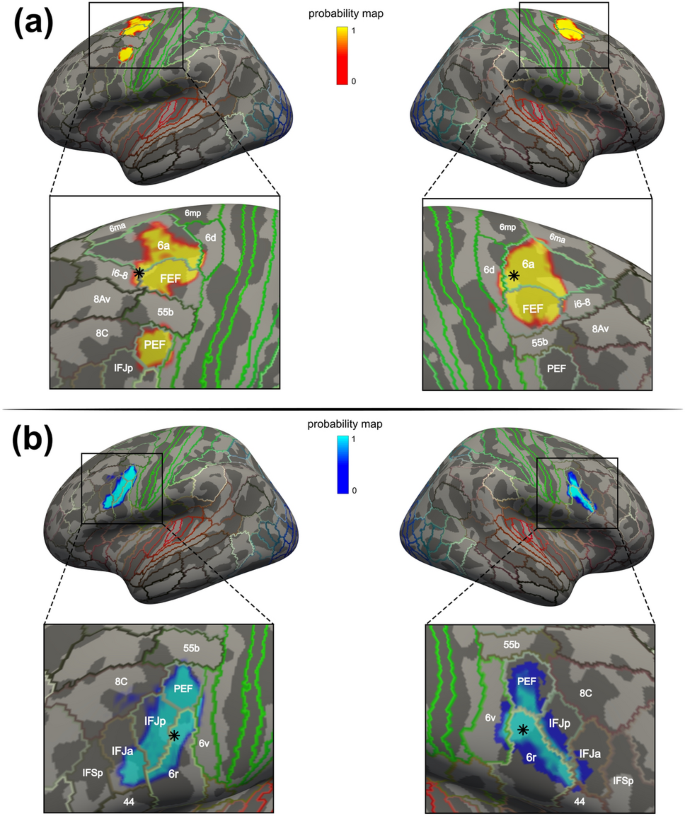
An ALE and MACM meta-analysis pins down the precise locations of the FEF and IFJ and maps the broader brain networks each one coactivates with

Read abstract

The frontal eye field (FEF) and the inferior frontal junction (IFJ) are prefrontal structures involved in mediating multiple aspects of goal-driven behavior. Despite being recognized as prominent nodes of the networks underlying spatial attention and oculomotor control, and working memory and cognitive control, respectively, the limited quantitative evidence on their precise localization has considerably impeded the detailed understanding of their structure and connectivity. In this study, we performed an activation likelihood estimation (ALE) fMRI meta-analysis by selecting studies that employed standard paradigms to accurately infer the localization of these regions in stereotaxic space. For the FEF, we found the highest spatial convergence of activations for prosaccade and antisaccade paradigms at the junction of the precentral sulcus and superior frontal sulcus. For the IFJ, we found consistent activations across oddball/attention, working memory, task-switching and Stroop paradigms at the junction of the inferior precentral sulcus and inferior frontal sulcus. We related these clusters to previous meta-analyses, sulcal/gyral neuroanatomy, and a comprehensive brain parcellation, highlighting important differences compared to their results and taxonomy. Finally, we leveraged the ALE peak coordinates as seeds to perform a meta-analytic connectivity modeling (MACM) analysis, which revealed systematic coactivation patterns spanning the frontal, parietal, and temporal cortices. We decoded the behavioral domains associated with these coactivations, suggesting that these may allow FEF and IFJ to support their specialized roles in flexible behavior. Our study provides the meta-analytic groundwork for investigating the relationship between functional specialization and connectivity of two crucial control structures of the prefrontal cortex.

PDF
Figure from Structure, function and connectivity fingerprints of the frontal eye field versus the inferior frontal junction: a comprehensive comparisonFigure
2021 · European Journal of Neuroscience

Structure, function and connectivity fingerprints of the frontal eye field versus the inferior frontal junction: a comprehensive comparison

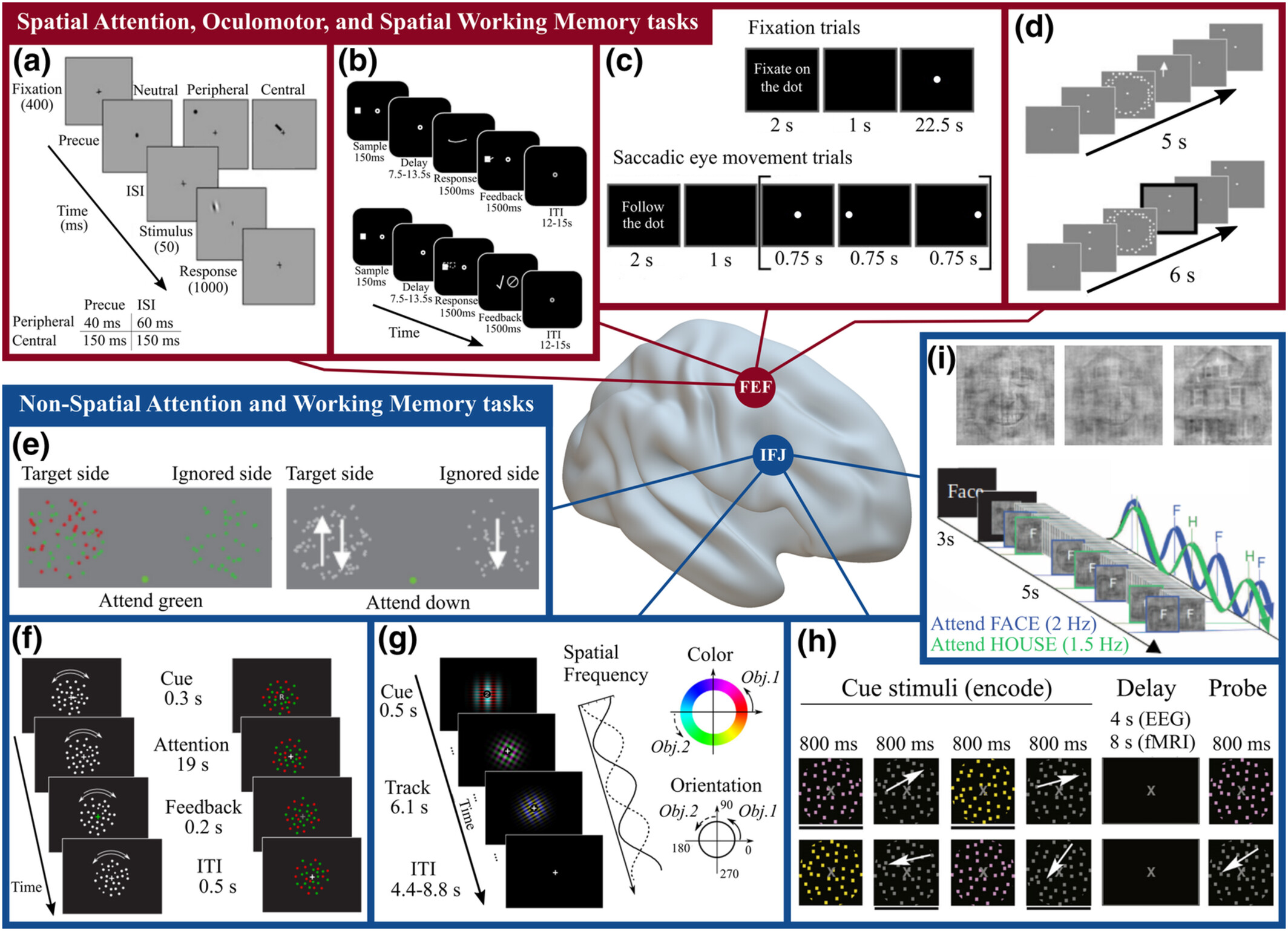
A review on FEF and IFJ separate roles in spatial versus non-spatial attention and working memory

Read abstract

The human prefrontal cortex contains two prominent areas, the frontal eye field and the inferior frontal junction, that are crucially involved in the orchestrating functions of attention, working memory and cognitive control. Motivated by comparative evidence in non-human primates, we review the human neuroimaging literature, suggesting that the functions of these regions can be clearly dissociated. We found remarkable differences in how these regions relate to sensory domains and visual topography, top-down and bottom-up spatial attention, spatial versus non-spatial (i.e., feature- and object-based) attention and working memory and, finally, the multiple-demand system. Functional magnetic resonance imaging (fMRI) studies using multivariate pattern analysis reveal the selectivity of the frontal eye field and inferior frontal junction to spatial and non-spatial information, respectively. The analysis of functional and effective connectivity provides evidence of the modulation of the activity in downstream visual areas from the frontal eye field and inferior frontal junction and sheds light on their reciprocal influences. We therefore suggest that future studies should aim at disentangling more explicitly the role of these regions in the control of spatial and non-spatial selection. We propose that the analysis of the structural and functional connectivity (i.e., the connectivity fingerprints) of the frontal eye field and inferior frontal junction may be used to further characterize their involvement in a spatial ('where') and a non-spatial ('what') network, respectively, highlighting segregated brain networks that allow biasing visual selection and working memory performance to support goal-driven behaviour.

PDF

Other publications